
Local and on-device · 2 November 2026
A small community model turns a description into editable 3D code
A community preview writes browser-based 3D scenes and exports game assets. Its November 2 checkpoint update is a specialised local-model development, not an official Qwen launch.
Who it affects
Indie game makers and technically comfortable hobbyists. It is a preview requiring a compatible local runtime, not a finished one-click modelling service.
Why it matters
A generated picture is fixed to one view. A 3D asset has structure that an editor can rotate, place and potentially animate.
What happened
CCORE updated the model’s GGUF checkpoints on November 2 at 04:50 UTC. The independent Qwen-based preview generates Three.js scenes with GLB export. The maintainer reports improved visual quality in personal tests; that claim has not been independently benchmarked here.
The model writes code that produces the asset rather than simply returning a finished image. The card notes that some outputs still need a retry or a code correction. The update retains the same filenames, making the actual checkpoint date relevant to comparisons.
What to do with it
- Enterprise
Teams considering generated assets should judge the exported object in the destination scene, not just a screenshot of the generator.
- Small businesses
A small game studio can explore rough props with a specialist model while reserving time for geometry and style cleanup.
- Individuals
Local experimentation requires a compatible runtime and sufficient hardware. A small model download is not a guarantee of effortless setup.
From words to an object you can turn around
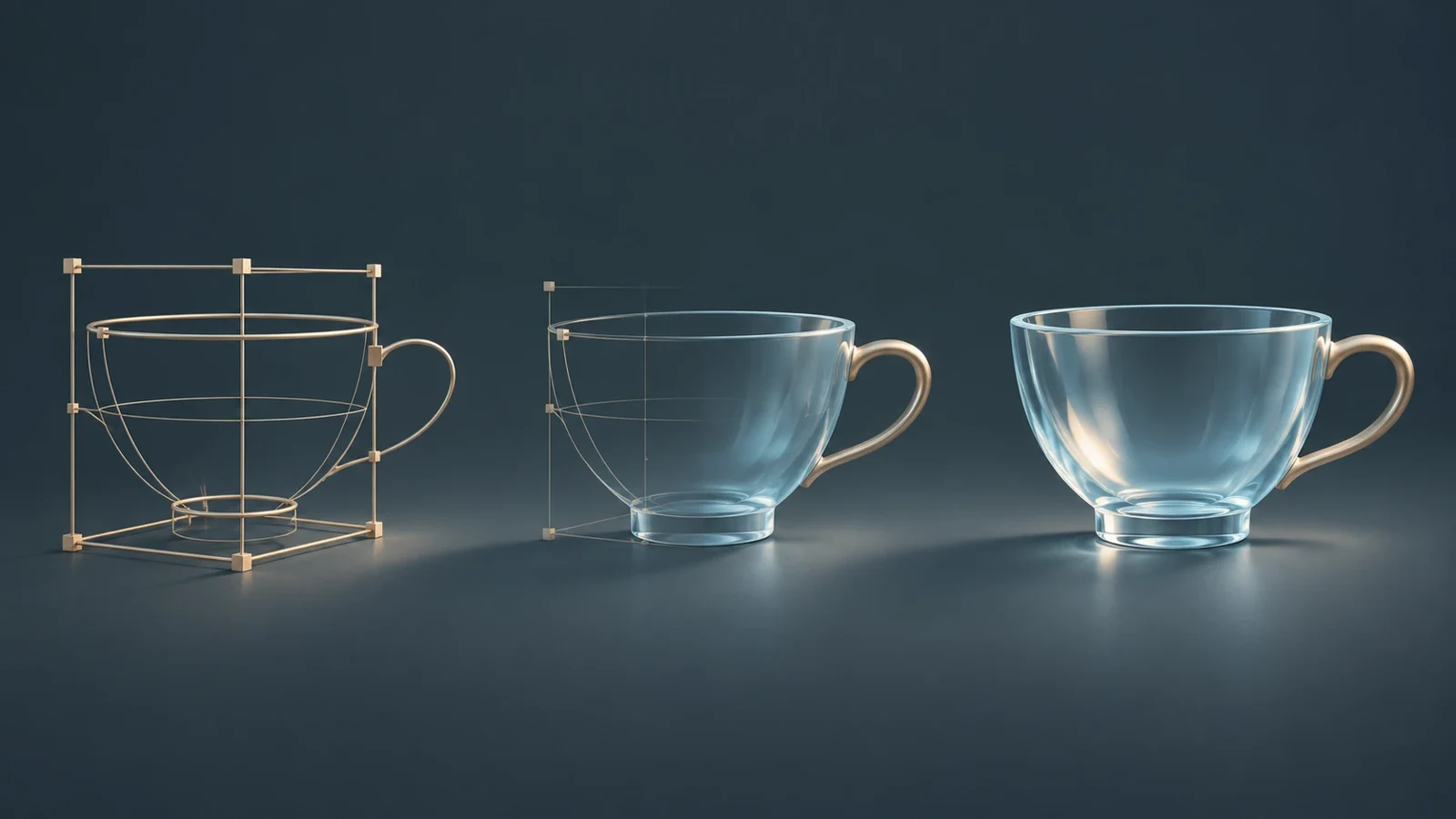
A picture of a cup may look convincing even if the unseen side would not make sense. Code for a 3D cup has to specify shapes and their positions. A rendering program then turns that structure into a view from a chosen angle.
This makes the output useful in a different way. A game maker can inspect the object from behind or place it beside another object. It also creates new ways to fail: an attractive front view does not guarantee a sensible shape from every direction.
An illustrative cup for a game
Suppose the request is for a low-detail cup with a handle. The generated scene looks fine head-on, but rotating it reveals that the handle floats a short distance away from the body. A flat image review would have missed the defect.
The creator can adjust the scene and inspect the exported object in the intended editor. Success means a usable asset in that setting, including its scale and orientation. It does not mean the object is suitable for physical manufacture. This is a hypothetical review example.
Terms to know
- Three.js
- A JavaScript library used to build and display 3D scenes in a browser.
- GLB
- A file format that can package a 3D model for transfer into compatible tools.
- GGUF
- A model-file format supported by several local inference programs.
What the sources show
- Confirmed
The card identifies an independent preview and dates the updated GGUF files to November 2 at 04:50 UTC.
- What may follow
Specialised models could make rough 3D asset exploration more accessible.
- What is not established
The maintainer’s quality improvement is not an independent comparison or an official Qwen release.