
Top stories · 17 August 2026
Singapore put living neurons in a computing rack. What can it actually do?
A Singapore research prototype connects living nerve cells to electronics. This August research catch-up explains the feedback loop, its purpose and the performance questions still unanswered.
Who it affects
Researchers studying cells and experimental computing are directly affected. Ordinary computer users and most businesses have no demonstrated reason from this announcement to change their hardware.
Why it matters
Two technologies can both be called biological AI while doing quite different things. Knowing whether living cells participate during operation helps explain what equipment is needed and what a performance claim would have to measure.
What happened
This is an August research catch-up, not a November launch. NUS Medicine reported on August 17 that NUS, infrastructure company DayOne and Cortical Labs had showcased a 20-unit CL1 biological-computing prototype on August 6. The demonstration showed live neural activity and the connection between cells and electronics. The announcement describes a research platform; it does not report a task-by-task comparison showing that it replaces conventional AI processors.
DayOne’s March 10 partnership announcement set out an initial benchmarking and technical-validation programme. Its possible expansion to 1,000 units was conditional on validation and regulatory approvals. That larger number should not be read as the size of the August installation. The sources reviewed for this article do not establish a later commercial-scale deployment.
What to do with it
- Enterprise
For a research partnership, request a named workload, its accuracy target, repeated results and the full energy-measurement boundary. Those details would make an evaluation meaningful; the rack count alone cannot justify a hardware purchase.
- Small businesses
Keep buying computing for the software you actually need to run. If a supplier uses “biological AI” in a pitch, ask whether that means live cells in operation or software inspired by laboratory work; the answer changes the practical requirements.
- Individuals
When sharing this story, retain the August dates and the distinction between a research demonstration and a proven replacement for AI chips. For the related video-model story, check what the software produces rather than assuming its name describes living cells inside your computer.
How cells become part of the experiment
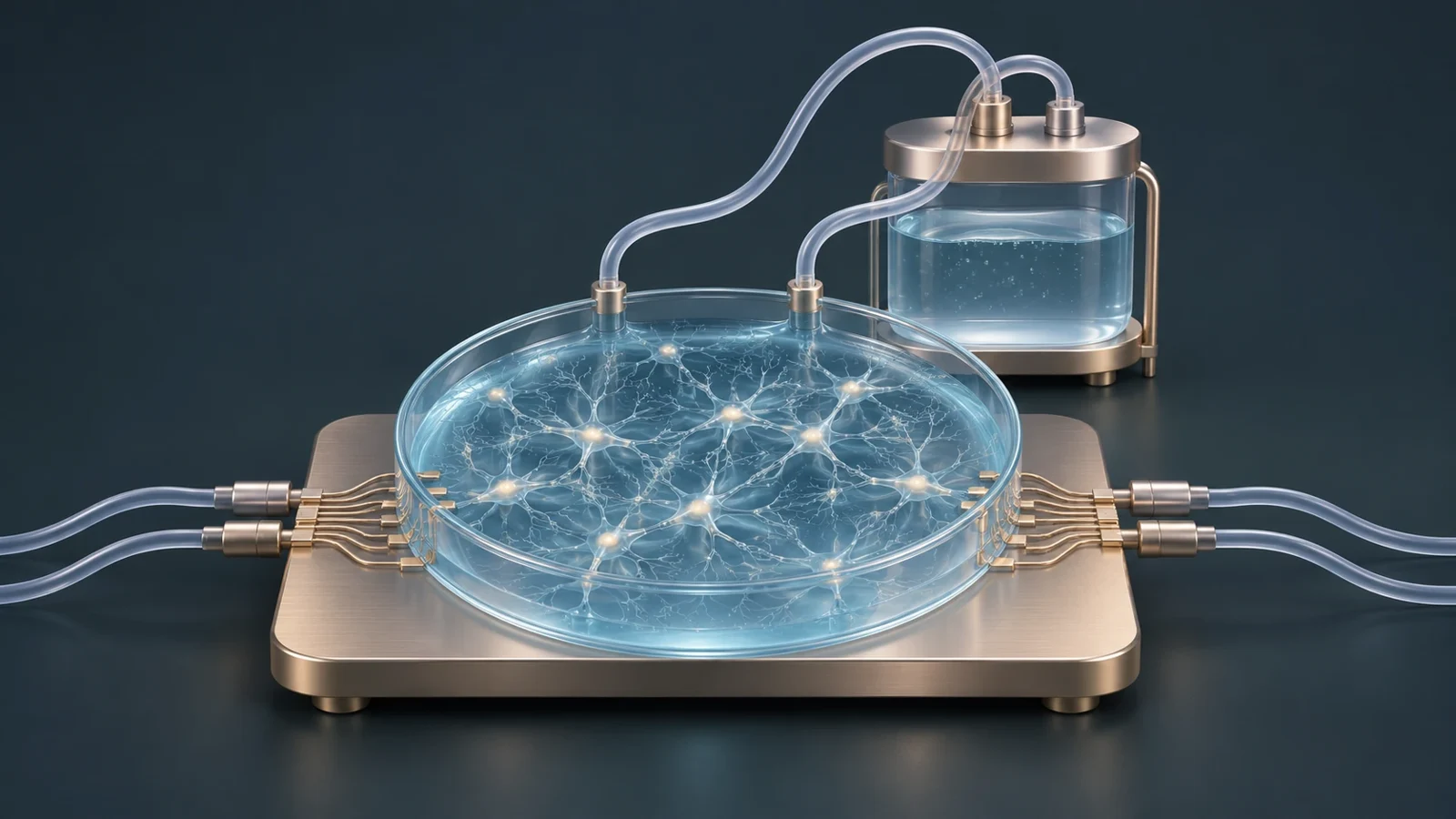
Cortical Labs describes neurons, the nerve cells that send electrical signals, growing across a chip in a nutrient solution. Tiny electrodes let the electronics stimulate the cells and record their responses. Software uses those responses to update a simulated environment, which can produce the next input. This repeating exchange is a closed loop: what comes out influences what goes in next.
The CL1 also supports the conditions needed to keep the cells alive. Its official product description therefore combines biology, electronics, software and life support. Calling it biological computing does not mean the silicon or ordinary computing equipment has disappeared. Researchers can inspect Cortical Labs’ public CL API documentation for examples of recording activity and sending stimulation commands; we have not run those experiments.
What would count as a useful result?
Imagine a hypothetical test that asks a system to distinguish two input patterns. A researcher would define how each pattern enters the system, how a response becomes an answer and how many answers are correct. Seeing electrical activity alone would not establish success: the activity must reliably support the assigned task. This is an explanatory example, not a reported result from the Singapore demonstration.
A fair efficiency comparison would then hold the task and required accuracy constant. A system that uses less electricity but gets many more answers wrong may not offer a useful saving. The measurement boundary would also need to state whether keeping the cells alive and operating supporting equipment is included. Results would need to be repeatable across runs and cell cultures. The August report does not supply those measurements.
Why this is different from Mischief 1
The Biological Computing Co explains in its own FAQ that its neuron-derived video technology runs as software on conventional AI hardware. It studies neurons in the laboratory to inform computational methods; living cells do not generate the videos. That is a different role for biology from the cells participating in CL1 experiments.
The two approaches therefore do not establish each other’s performance. A software video model needs tests of its output and running conditions. A live-cell research platform needs defined experiments and measurements of the complete system. Neither label tells a reader which will be useful for a particular job.
Terms to know
- Neuron
- A nerve cell that receives and sends electrical signals.
- Electrode array
- A group of small electrical contacts used to stimulate cells and record their activity.
- Closed loop
- A repeating interaction in which the measured response affects the next input.
- Benchmark
- A defined task and scoring method used to compare performance under stated conditions.
What the sources show
- Confirmed
The institutional report identifies a 20-unit prototype and an August demonstration. Cortical Labs documents cell/electrode interaction; TBC describes its video technology as software rather than live-cell execution.
- What may follow
An integrated platform could make biological-computing experiments easier to conduct. That possibility does not establish a commercially useful computing advantage; reproducible task results are still needed.
- What is not established
The reviewed sources do not establish a GPU replacement, a task-normalized whole-system energy advantage or an operating 1,000-unit Singapore deployment. These are limits of what can be concluded, not allegations that the prototype failed.